Uncertain impact of California’s high school exit exam
FERMIN LEAL/EDSOURCE TODAY
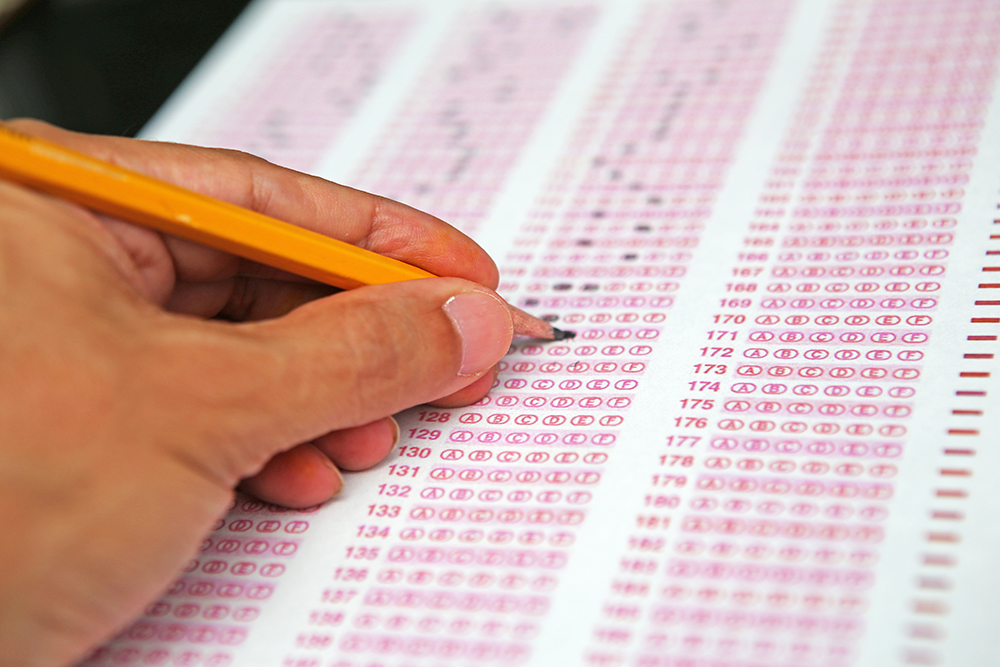
The California High School Exit Exam was required for graduation later on 2006.
 FERMIN LEAL/EDSOURCE TODAY
The California High School Exit Examination was required for graduation subsequently 2006.
As the state looks to replace the California High School Exit Exam with a new version, or eliminate information technology altogether as a graduation requirement, information technology remains difficult to discover much consensus among educators, researchers and advocates regarding the legacy of the test for California.
Gov. Dark-brown last week signed legislation that exempted students from the graduating class of 2022 from having to take the exam in response to a snafu that left thousands of seniors without the power to have the test several more times as permitted under land constabulary.Still to be resolved is the bigger issue of the fate of the test itself, which may exist partly determined by assessing its impact since it became a graduation requirement nearly a decade ago.
The California High School Exit Exam (CAHSEE) debuted in 2001 as an effort aimed at ensuring every pupil graduated from high school with basic skills and, as the California Department of Pedagogy spelled out, "to identify students who are not developing skills that are essential for life later on high schoolhouse."
Nearly 5 million students accept taken the test since then. A majority of students passed on their outset endeavor, with an increasing number each year that the test has been administered.
Some, however, have struggled through multiple attempts before successfully completing it. Virtually 249,000 students have failed the test since it became a graduation requirement in 2006.
Supporters of the go out test say the exam has raised the bar for graduation past encouraging students to work harder and pressured schools to increase their efforts to close the achievement gap.

Photo by Tiffany Lew/EdSource
Document of Achievement awarded to Prospect High student Arlene Holmes instead of diploma because she didn't pass the California High Schoolhouse Exit Exam.
Opponents argue that the test has discouraged some low-achieving students from staying in schoolhouse and that it disproportionately punished low-income children and English learners who were unable to pass the exam.
The research the state commissioned each year to evaluate theexit exam was generally positive nearly its impact, but other research reports were more than disquisitional. (For an overview of the research, encounter the finish of this article.)
After an extended debate on the event, Gov. Gray Davis signed legislation in 1999 to create the exit exam equally a status for students to receive a high school diploma. At the time, California joined a growing number of states that had such a requirement. By 2002, 24 states administered exit exams. Ten years later that number had grown to 26.
At the time he signed the law, Davis said the exam would add value to a diploma past ensuring students showed competency in math, reading and writing before they finished high schoolhouse.
Students were tested on their bent in tenth-class English and algebra, which students typically took between the eighth and tenth class. Students could first take the test as sophomores, and if they didn't pass, they could take information technology up to six more times before the terminate of their senior year. Even if they had not passed it past then, they could also take the exam upward to three times in the twelvemonth after their senior year and exist awarded a diploma if they eventually passed.

CLICK ON THE Image TO SEE A LARGER VIEW: This table shows the rate of students passing the California High Schoolhouse Go out Test by the end of their senior twelvemonth. Source: HumRRO
The test was showtime administered to freshman students in 2001, and they were required to pass it earlier they graduated in 2004. Past 2002, only four in 10 students from the class of 2004 had passed the test, prompting lawmakers to postpone it as a graduation requirement another ii years.
Virtually 91 percent of students in the form of 2006 passed by the finish of their senior yr, including 67 percent who passed on their start try as sophomores. By 2014, about 95.five pct of seniors passed, including xc percent who passed on their first endeavour equally sophomores.
But given California's size, even a pocket-size percentage of students failing the tests translates into large numbers of actual students. Last year, for case, iv.5 per centum of high school students couldn't pass the test by the end of their senior yr. That amounts to nigh 20,000 seniors.
Onetime state Superintendent Jack O'Connell authored the legislation that created the exit test when he was a land senator in 1999.
"I didn't want a high school diploma to but reverberate a certification of seat time," O'Connell, who served as state superintendent from 2003 to 2011, said in a recent interview. "It should mean something much more. Information technology should reflect the pedagogy we are delivering to our students."
O'Connell, now a partner at Capitol Advisors Group, a Sacramento-based consulting business firm, said the exam helped educators better target which students needed the almost support past funneling them into intervention programs that helped improve their overall academic success.
"If you talk with folks in the field, this is one of the virtually meaning reforms in high school they've seen," he said.
The erstwhile state superintendent said results that show a higher rate of students from at-risk groups passing the test by 2022 compared to 2006 proves the get out exam accomplished one of its biggest goals.
"I didn't want a high schoolhouse diploma to only reverberate a certification of seat time. Information technology should mean something much more," said quondam State Superintendent Jack O'Connell.
In 2006, almost 86 per centum of low-income students, 73 percentage of English learners, 85 per centum of Latino students and 84 percent of black students passed by the end of their senior year. By 2014, about 94 percent of depression-income students, 82 percent of English learners, 94 per centum of Latinos and 92 percent of black students passed.
"This test helped close the achievement gap," he said.
O'Connell said he now supports Senate Neb 172, which proposes to suspend the get out exam through 2017-18 to give the country time to decide whether a new exam should be administered that is aligned with the Mutual Core standards.
"It was never intended to become on indefinitely," he said. "Once Common Core came in, I knew information technology would be the stop for an exam that's based on California'southward previous state standards."
Challenging the exam'southward effectiveness
Critics take said in that location is piffling evidence the exam alone helped heave accomplishment of at-risk students. Some have said that other accountability systems implemented at the same time, including the federal No Child Left Backside Act and the country's Academic Functioning Index, contributed more than to pressuring schools to improve accomplishment amongst all student groups. Instead, critics said, there is meaning bear witness the get out exam prevented many English learners, minority and low-income students from earning a loftier school diploma.
Arturo González, an attorney with the San Francisco police house of Morrison & Foerster, filed a lawsuit in 2006 on behalf of a group of students from Richmond who sued the state in Valenzuela v. O'Connell, challenge poor and minority students were at a disadvantage because of sub-par teachers and resources in low-performing schools.
"This was a worthless examination," González said. "The simply thing it did was deny deserving students a diploma. In my view, it was more than a political move by educators to show they were doing something."
An Alameda County Superior Court judge in May of 2006 ruled that the exit exam could not be used to deny students a high school diploma, but three months subsequently the lawsuit was filed. But the state Supreme Courtroom reinstated the exam a few weeks afterwardafter the state appealed the lower courtroom'south ruling.
González said the fact that the vast majority of students failing the get out examination are low-income, English learners, Latinos and blacks proves the cess is flawed. Of the xix,679 students from the class of 2022 who did not pass by the end of their senior year, 68 percent were Latino, 49 percent were English learners and 77 percent were low-income, according to country Department of Education figures. (Some of these students fit into multiple categories.)
González said that if the land really wanted to ameliorate achievement among at-risk students, it should take invested the millions of dollars it toll to create and implement the test on more AP courses, teacher training, after-school programs and tutoring in schools in disadvantaged neighborhoods.
Students without diplomas
Students at many school districts across the country who met all other graduation requirements except for the exit examination accept instead been awarded certificates of completion, a diploma-like document that looks similar a high school diploma and states that the pupil met all of their private commune'south graduation requirements. But the certificate does not carry the same weight as an actual diploma when applying to college or for jobs. It is not known how many districts offer certificates of completion in lieu of a high school diploma considering the state does not rails those numbers.
Most 4-year colleges, including the University of California and the California State University systems, decide whether to admit applicants with certificates of completion on a case-by-case basis. Students without diplomas in districts that chose non to award certificates of completion are often encouraged to enroll in community colleges, which don't require diplomas, or work toward passing the Full general Educational Development examination, or GED, a high school equivalency exam.
"I've had and then many doors of opportunity slammed in my confront for not having my diploma," said Telesis Radford, who could not pass the exam before the end of her senior twelvemonth.
Arlene Holmes received her certificate of completion in 2022 from Prospect High School in Pleasant Hill in Contra Costa County. Holmes easily passed the English portion, she said. Just the math proved too difficult.

TIFFANY LEW/EDSOURCE TODAY
Arlene Holmes has been denied jobs and entrance into some training programs considering she has not yet passed the CA High School Exit Exam.
"It is ridiculous how I actually worked extremely hard to fifty-fifty cease high school dorsum in 2012," she said.
Holmes, at present 21, said not earning a diploma prevented her from enrolling in a vocational nursing program and other trade schools.
"I would accept done a lot more with college and jobs because I am very capable," she said. Holmes has received task offers, but was later told by human resources departments that they couldn't hire her until she's earned a diploma.
Telesis Radford received a certificate of completion from Santa Rosa Loftier School in 2006 later on failing the math department by just a few points.
"Information technology was a distressing and devastating day for me when I learned I wouldn't receive my high school diploma," Radford said. "I've had so many doors of opportunity slammed in my face for not having my diploma."
Radford, now 27, was unable to enroll in a medical technician program, where she hoped to earn a phlebotomy license, which would let her to work in a dispensary or hospital drawing blood from patients.
"If I had my diploma, I would be in the medical field, and I would not be struggling like I am today to accomplish and achieve my dreams," said Radford, who currently works as an administrative coordinator for the American Red Cross.
Lucinda Pueblos, assistant superintendent for K-12 performance and culture in Santa Ana Unified, said she has "mixed emotions" about the exit exam. Pueblos previously served as principal at Century High Schoolhouse, which too awarded certificates of completion.
While the exam overall set up minimal expectations for students, it was still difficult for new English language learners to laissez passer the English section, she said. "Information technology really did present a barrier for a lot of students."
When the get out exam started, educators had to identify a stronger focus on reading, writing and algebra in centre school in training for the examination, said Pueblos, who also previously worked as a heart school master. The pass rates improved, as students were better prepared.
She said the exam achieved its goal. "We were at to the lowest degree able to say they are at an 8th-grade level when they graduate," she said.
Education Trust-West, an advocacy group for minority and low-income students, has generally supported the leave exam as some other tool that helps increase the focus on struggling students.
"It prevented these students from being invisible," said Carrie Hahnel, manager of research and policy analysis at Didactics Trust-West. "It put responsibility and pressure on the system to help students."
Hahnel said the yearly test scores helped highlight the achievement gap for educators and policy makers. "The exam provided a lot of good information," she said. "It also made the point that a high school diploma has to hateful something, that y'all demand these basic skills for college and careers."
What the Enquiry Shows
Homo Resources Research Organization, or HumRRO, an independent evaluator, was deputed by the state to review results of the leave exam each year since the program began. Its reports have more often than not been favorable, linking increased graduation rates and overall academic proficiency to the get out test. The research grouping concluded in its most contempo report in November 2022 that, "over fifteen years, we have seen examination scores ascension overall and for demographic groups divers by race/ethnicity and economic status. Graduation rates climbed, dropout rates declined, and successful participation in higher entrance exams and Advanced Placement exams rose."
HumRRO too reported that the exam has prompted schools across the land to create remedial opportunities for students who needed aid passing it.
"Available evidence suggests that students have worked hard to meet the current (exit examination) requirement and that teachers have used class time to assistance them do so," co-ordinate to HumRRO'south latest written report.
The report ended that a college rate of high school students are enrolling in advanced math courses, including geometry, intermediate algebra and calculus, every bit a upshot of the exit exam's focus on algebra proficiency.
Still, HumRRO acknowledged that although scores for some minority groups, low-income students and English language learners go along to meliorate, these students go on to lag significantly behind their peers.
A 2009 study by Stanford University professor Sean Reardon and UC Davis professor Michal Kurlaender ended that the go out exam "has had no positive furnishings on students' bookish skills. Students field of study to the (exam) requirement – particularly low-achieving students whom the test might take motivated to work harder in school – learned no more between 10th and 11th class than similar students in the previous cohort who were non bailiwick to the requirement."
The report compared 11th-course scores on California Standards Tests, or CSTs, beyond years when the exit exam was a graduation requirement with years when it was not. On boilerplate, CST scores were slightly lower amid students subject to the go out exam every bit a graduation requirement, co-ordinate to the study. Information technology also fabricated the instance that graduation rates of minority students who were struggling academically declined equally a result of them failing the exam – far more than than the graduation rates of white students:
"The graduation rate for minority students in the bottom accomplishment quartile declined by 15 to 19 percentage points afterward the introduction of the exit exam requirement, while the graduation rate for like white students declined past simply 1 percentage point. The analyses further suggest that the disproportionate effects of the CAHSEE requirement on graduation rates are due to large racial and gender differences in CAHSEE passing rates amongst students with the same level of achievement."
Reardon and Kurlaender said at the time that since the test wasn't working as it was intended, the state should consider eliminating information technology as a graduation requirement.
The Public Policy Institute of California released a study in 2008 that used the grades, test scores and behavior of 4th graders to reliably predict whether students would pass the exit exam. The study concluded the best fashion to ensure more students pass was to target intervention programs well before students begin high school. The written report did not address the effectiveness of the exit examination.
Other studies over the years on exit exams nationally, including those from the Center on Didactics Policy and the Education Commission of usa, have too reported that the exams are most effective when states provide enough back up to help struggling students eventually pass.
EdSource Today reporter Sarah Tully contributed to this report.
To become more reports similar this ane, click hither to sign up for EdSource'due south no-price daily email on latest developments in education.
Source: https://edsource.org/2015/uncertain-impact-of-californias-high-school-exit-exam/85387
0 Response to "Uncertain impact of California’s high school exit exam"
Post a Comment