Small Shack Hut That Can Be Used for Housing

This is a listing of house types. Houses tin be built in a large diversity of configurations. A bones division is betwixt gratis-standing or single-family detached homes and various types of attached or multi-family unit residential dwellings. Both may vary greatly in scale and the amount of accommodation provided.
By layout [edit]
Single-pile house layouts are 1 room deep, simply may be more than than ane room broad[1]

Double pen or double prison cell: a 2-room house[3]
- Saddlebag: a ii-room house with a primal chimney and one or two front doors[4]

Key-passage or central hallway\corridor: a iii-room house, with a central hallway or passage running front-to-back between the two rooms on either side of the business firm[vi]
- Dogtrot house: divided house with an open up, roofed breezeway between the 2 sections[7]
Double-pile house layouts are two rooms deep, and also may be more than one room wide[8]

Shotgun house: a house that is one room wide and 2 rooms deep, without a corridor[9]

Side-hall or side passage: a house with a hallway that runs from front to back forth one side[10]
Hut [edit]
A Hut is a dwelling of relatively simple construction, usually ane room and one story in peak. The design and materials of huts vary widely around the world.
-

Broch: a Scottish roundhouse
-
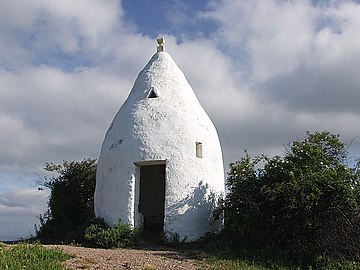
Trullo: a traditional Apulian stone dwelling with a conical roof
-

Bungalow [edit]
Bungalow is a common term applied to a low i-story house with a shallow-pitched roof (in some locations, dormered varieties are referred to as one.5-story, such every bit the chalet bungalow in the United Kingdom).[xi]
Cottage [edit]
A Cottage is a small house, usually one story in peak, although the term is sometimes applied to larger structures.
-

Greatcoat Cod-style house or Cape: a style of a double-pile one-story cottage; low, wide with a steep side-gable roof to which dormers are often added to create a second story (in some locations, referred to as 1.5-story)
-
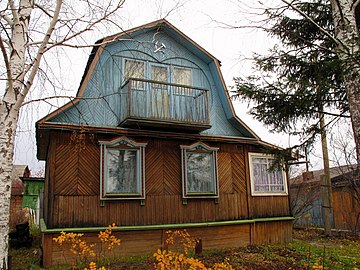
Dacha: cottage-type house in Russia and quondam marriage republics of the Soviet Spousal relationship
-
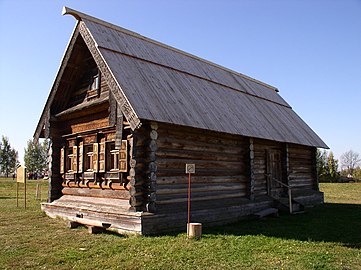
Izba: a traditional Russian wooden land business firm
-

Ontario Cottage: a one- or one-and-a-one-half-story house with a symmetrical rectangular floor programme and a gable centred over the door, popular in small-town Ontario during the 19th century
Ranch [edit]

A Ranch-style house or Rambler is 1-story, depression to the ground, with a low-pitched roof, usually rectangular, L- or U-shaped with deep overhanging eaves[12] Ranch styles include:
- California ranch: the "original" ranch style, developed in the United States in the early 20th century, before Earth War Two[13]
- Tract ranch: a mail service-World War II mode of ranch that was smaller and less ornate than the original, mass-produced in housing developments, usually without basements[13]
- Suburban ranch: a mod fashion of ranch that retains many of the characteristics of the original simply is larger, with modern civilities[13]
I-house [edit]

Southern I-House style home
An I-firm is a two-story house that is ane room deep with a double-pen, hall-parlor, fundamental-hall or saddlebag layout.[14]
- New England I-business firm: characterized by a central chimney[15]
- Pennsylvania I-firm: characterized past internal gable-end chimneys at the interior of either side of the house[15]
- Southern I-business firm: characterized by external gable-cease chimneys on the outside of either side of the house[xv]
Gablefront [edit]
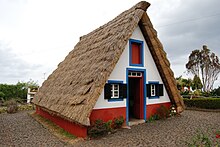
A-frame gable-way house, Portugal
A Gablefront firm or Gablefront cottage has a gable roof that faces its street or avenue, as in the novel The Firm of Seven Gables.
- A-frame: so-called because the steep roofline, reaching to or near the ground, makes the gable ends resemble a majuscule letter A.
- Chalet: a gablefront house congenital into a mountainside with a broad sloping roof
- Charleston single house: originating in Charleston, South Carolina, a narrow firm with its shoulder to the street and front door on the side.
Separate-level [edit]
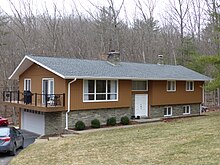
Divide-level house is a design of house that was usually built during the 1950s and 1960s. It has two nearly equal sections that are located on two different levels, with a curt stairway in the corridor connecting them.
- Bi-level, separate-entry, or raised ranch [sixteen]
- Tri-level, quad-level, quintlevel etc. [16]
Tower [edit]

Vao tower house in Estonia, built in 15th century
A Tower firm is a compact two or more story house, often fortified.
- Irish tower houses were often surrounded by defensive walls chosen bawns
- Kulla: an Albanian tower house
- Peel tower or Pele tower: fortified tower houses in England and Scotland used as keeps or houses
- Vainakh tower: a belfry house found in Chechenya and Ingushetia that reached up to iv stories alpine and were used for residential or military machine purposes, or both
- Welsh tower houses: built mostly in the 14th and 15th centuries
Longhouse [edit]
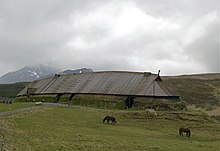
reconstructed Viking longhouse
A Longhouse is historical firm blazon typically for family unit groups.
- Geestharden house: ane of the three bones house types in Schleswig-Holstein region of Germany
- Uthland-Frisian house: a sub type of Geestharden house of northwest Deutschland and Denmark
- Longère: a long and narrow house in rural Normandy and Brittany
Housebarn [edit]

A Housebarn is a combined firm and barn.
- Barndominium: a type of house that includes living infinite attached to either a workshop or a barn, typically for horses, or a big vehicle such equally a recreational vehicle or a large recreational boat
- Byre-abode: farmhouse with people and livestock nether ane roof
- Continued farm: type of farmhouse common in New England
- Frutighaus: a type of barnhouse originating in the Frutigland region of Switzerland.
Other house types [edit]
- Courtyard house
- Riad: a type of courtyard house found in Morocco
- Siheyuan: a type of courtyard business firm plant in Communist china
- Snout house: a house with the garage door existence the closest part of the home to the street.
- Octagon house: a business firm of symmetrical octagonal flooring plan, popularized briefly during the 19th century by Orson Squire Fowler
- Stilt firm: is a firm congenital on stilts above a body of water or the basis (usually in swampy areas prone to flooding).
- Villa: a large house which one might retreat to in the state. Villa tin can also refer to a freestanding comfy-sized house, on a large cake, generally found in the suburbs, and in Victorian terraced housing, a house larger than the average byelaw terraced house, frequently having double street frontage.
- Mansion: a very large, luxurious house, typically associated with exceptional wealth or aristocracy, unremarkably of more than one story, on a very large block of land or estate.
Mansions unremarkably will accept many more rooms and bedrooms than a typical single-family dwelling house, including specialty rooms, such equally a library, study, solarium, theater, greenhouse, infinity pool, bowling alley, or server room.
By construction method or materials [edit]

- Airey house: a type of low-cost house that was adult in the United Kingdom during the 1940s by Sir Edwin Airey, and then widely constructed betwixt 1945 and 1960 to provide housing for soldiers, sailors, and airmen who had returned home from Globe State of war Two. These are recognizable by their precast concrete columns and by their walls made of precast "transport-lap" physical panels.
- Assam-blazon House: an earthquake-resistant house type normally found in the northeastern states of India
- Bastle house: a fortified farmhouse plant in England and Scotland
- Castle: primarily a defensive construction/domicile built during the Night Ages and the Middle Ages, and also during the 18th century and the 19th century.
- Converted barn: an old barn converted into a firm or other utilise.
- Earth sheltered: houses using clay ("earth") piled against it outside walls for thermal mass, which reduces heat flow into or out of the house, maintaining a more steady indoor temperature
- Pit-house: a prehistoric business firm type used on many continents and of many styles, partially sunken into the ground.
- Rammed earth
- Sod house
- Souterrain: an earthen dwelling typically deriving from Neolithic Historic period or Statuary Age times.
- Hole-and-corner home: a type of habitation dug and constructed underground. Ex. A Rammed-World Style Firm
- Yaodong: a dugout used equally an domicile or shelter in northern China, particularly on the Loess Plateau
- Wattle and daub
- Adobe: a blazon of mudbrick house fabricated of dirt and straw with mud used equally mortar. Institute throughout the world, in particular Spain, North Africa, the Center E and the Americas.
- Igloo: an Inuit, Yup'ik, and Aleut seasonal or emergency shelter that was fabricated of knife-sliced blocks of packed snowfall and/or ice in the Arctic regions of Alaska, Canada, Greenland, and Siberian Russia.
- Kit house: a type of pre-made business firm made of pre-cut, numbered pieces of lumber.
- Sears Catalog Home: an possessor-built "kit" houses that were sold by the Sears, Roebuck and Co. corporation via catalog orders from 1906 to 1940.
- Laneway house: a type of Canadian house that is constructed behind a normal single-family dwelling that opens onto a back lane
- Log home, Log cabin: a house built past American, Canadian, and Russian frontiersmen and their families which was built of solid, unsquared wooden logs and afterward as a well crafted style of dwelling
- Plank house: a general term for houses congenital using planks in a diverseness of ways
- Pole house: a timber house in which a set of vertical poles acquit the load of all of its suspended floors and roof, allowing all of its walls to be non-load-begetting.
- Prefabricated house: a house whose main structural sections were manufactured in a factory, and so transported to their final building site to be assembled upon a physical foundation, which had to exist poured locally.
- Manufactured house: a prefabricated house that is assembled on the permanent site on which it will sit.
- Modular home: a prefabricated house that consists of repeated sections called modules.
- Lustron business firm: a type of prefabricated firm
- Stilt houses or Pile dwellings: houses raised on stilts over the surface of the soil or a body of h2o.
- Tree firm: a house built amidst the branches or around the torso of one or more mature trees and does not remainder on the ground.
- Upper Lusatian house or Umgebinde: combined log and timber-frame construction in Deutschland-Czech republic-Poland region
- Wimpey no-fines house: a low-cost semi-fastened or terraced houses built in the United Kingdom from the 1940s onwards using concrete without fine aggregates ("no-fine")
Single-family fastened [edit]
- Two-family or duplex: two living units, either fastened side by side and sharing a common wall (in some countries, chosen semi-discrete) or stacked i atop the other (in some countries, called a omnibus)
- Three-family or triplex: three living units, either attached adjacent and sharing common walls, or stacked (in some countries, chosen a three-decker or triple-decker)
- Four-family unit or quadplex or quad: 4 living units, typically with ii units on the first floor and two on the second, or side-by-side
- Townhouse, terraced house, or rowhouse: common terms for unmarried-family attached housing, whose precise meaning varies by location, often connecting a series of living units arranged side-by-side sharing common walls (non to be confused with the English term for an aristocratic mansion, townhouse (Great United kingdom of great britain and northern ireland))
- Linked firm: side-past-side fastened houses that appear detached above-ground but are attached at the foundation below-ground
- Linked semi-discrete: side-by-side attached houses with garages in between them, sharing basement and garage walls
- Mews property: an urban stable-block that has often been converted into residential properties. The houses may have been converted into footing floor garages with a small flat above which used to firm the ostler or just a garage with no living quarters.
- Patio house: townhouses that share a patio
- Weavers' cottage: townhouses with attached workshops for weavers
Movable dwellings [edit]
- Chattel business firm: a small wooden house occupied by working-class people on Barbados. Originally relocatable; personal chattel (belongings) rather than fixed real property.

- Mobile home, park domicile, or trailer home: a prefabricated firm that is manufactured off-site and moved by trailer to its final location (simply not intended to be towed regularly past a vehicle)
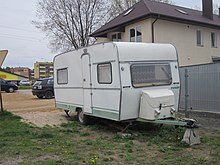
- Recreational vehicle or RV: a motor vehicle or trailer that can be used for habitation
- Travel trailer, camper or caravan: a trailer designed to be used as a residence (commonly temporarily), which must be towed regularly by a vehicle and cannot move under its own power
- Tiny house: a trailer, often 500 square feet (46 1000two) or smaller, congenital to look similar a small house and suitable for long-term habitation
- Houseboat includes bladder houses: a gunkhole designed to be primarily used as a residence
- Tent: a temporary, movable dwelling ordinarily constructed with cloth covering a frame of lightweight wood or other locally-bachelor material
- Tipi: a conical tent originating in Northward America
- Yurt: a circular tent with a conical roof originating in Central Asia
Run across also [edit]
- Cohousing
- Visitor boondocks
- Metropolis block
- Home
- House
- Gated customs
- Intentional Community
- Listing of house styles
- Planned Unit Development
- Real estate
- Spite firm, which may or may not be attached to other structures
- Sustainable blueprint
- Timeshare, form of holiday property
Notes [edit]
- ^ Harris 2006, p. 892, Single-pile firm: A house that is just one room deep"
- ^ Cloues 2005, Single Pen: "A one-room business firm, commonly gable-roofed with an end chimney"; Harris 2006, p. 490, Hall: "4. A small, relatively primitive dwelling house having a one-room plan."
- ^ Cloues 2005, Double Pen: "A two-room business firm with two front doors, ordinarily gable-roofed with end chimneys"
- ^ Cloues 2005, Saddlebag: "A 2-room business firm with a fundamental chimney and one or 2 forepart doors, ordinarily gable-roofed"
- ^ Cloues 2005, Hall-Parlor: "A two-room house with unequal-sized rooms and one front door, usually gable-roofed"
- ^ Cloues 2005, Central Hallway: "A two-room firm with a central hall and centered front door, usually gable-roofed with end chimneys"
- ^ Cloues 2005, Dogtrot: "A 2-room house with an open center passage"
- ^ Harris 2006, p. 328, Double-pile firm: A house that is two rooms deep"
- ^ Cloues 2005, Shotgun: "A one-room wide business firm, two or more rooms deep, without a hallway; gable- or hip-roofed"
- ^ Harris 2006, pp. 887–888, Side-hall programme, side passage programme: "A floor plan of a house having a corridor that runs from the front to the back of the firm forth one exterior wall; all rooms are located on the aforementioned side of the corridor."
- ^ Cloues 2005, Bungalow: "A house relatively long and low in proportion, rectangular in plan, with an irregular interior floor plan, featuring integral porches and low-pitched roofs"
- ^ Cloues, Ranch House: "A house with long, low proportions and extended rectangular program, sometimes with 50- or T-shaped extensions at one or both ends, rooms amassed with family unit living spaces at ane terminate and bedrooms at the other finish, often with integral carport or garage; low gabled or hipped roof" sfnm fault: no target: CITEREFCloues (help); Poore 2018; Salant 2006.
- ^ a b c Poore 2018; Salant 2006.
- ^ Cloues 2005, I-House: "A 1-room-deep house with a distinctive tall, narrow contour; floor plans include fundamental hallway, hall-parlor, double-pen, and saddlebag; often with rear shed or porch"
- ^ a b c Nostrand 2018, pp. 102–104.
- ^ a b McAlester 2013, pp. 613–614. sfn error: no target: CITEREFMcAlester2013 (help)
References [edit]
- Cloues, Richard (2005-03-26). "Business firm Types". New Georgia Encyclopedia (2013-08-22 ed.). Georgia Humanities and the Academy of Georgia Press. Retrieved 2018-12-28 .
- Harris, Cyril One thousand. (2006). Dictionary of Architectures & Construction (4th ed.). NY: McGraw-Hill. ISBN0-07-158901-5.
- McAlester, Virginia; McAlester, Arcie Lee (2013). A Field Guide to American Houses: The Definitive Guide to Identifying and Agreement America'south Domestic Architecture. Alfred A. Knopf. ISBN9781400043590.
- Nostrand, Richard L. (2018-01-19). The Making of America's Culture Regions. Rowman & Littlefield. ISBN9781538103975.
- Poore, Patricia (2018-06-05). "The California Ranch". Old Firm Journal Magazine. Archived from the original on 2019-01-01. Retrieved 2019-01-01 .
- Salant, Katherine (2006-12-30). "The Ranch, an Architectural Archetype Forged on the Borderland". The Washington Post. Archived from the original on 2019-01-01. Retrieved 2012-12-31 .
External links [edit]
- House Images
- Architectural Housing Styles at Old Firm Web
- Bilingual Glossary of House types (in English and Castilian)
- A comprehensive summary of mutual residential architectural styles and themes
Source: https://en.wikipedia.org/wiki/List_of_house_types
0 Response to "Small Shack Hut That Can Be Used for Housing"
Post a Comment